
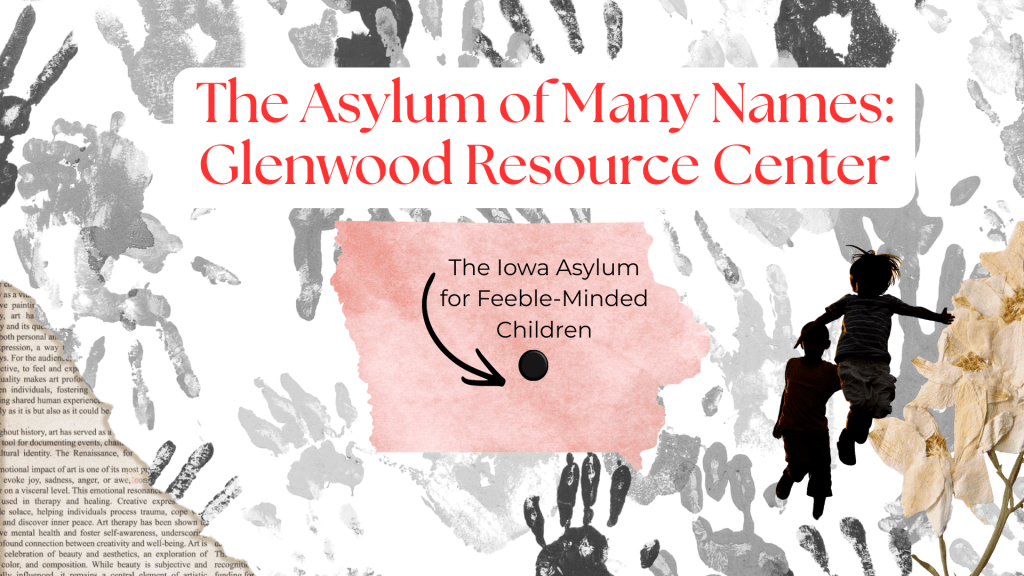
Glenwood, Iowa
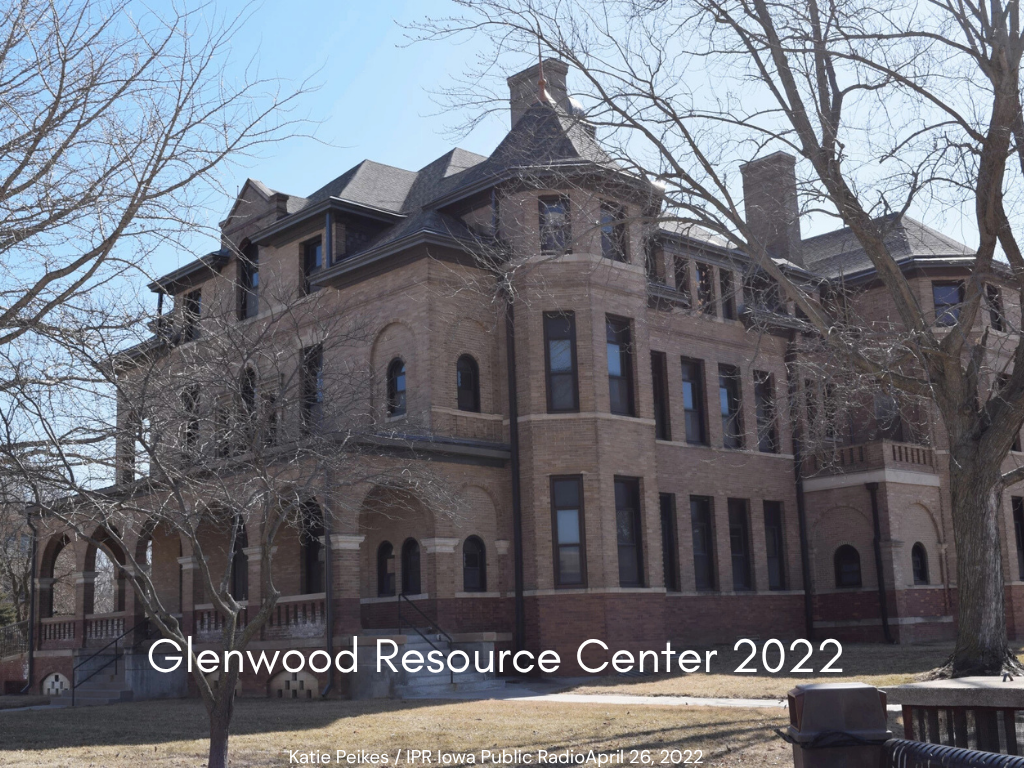
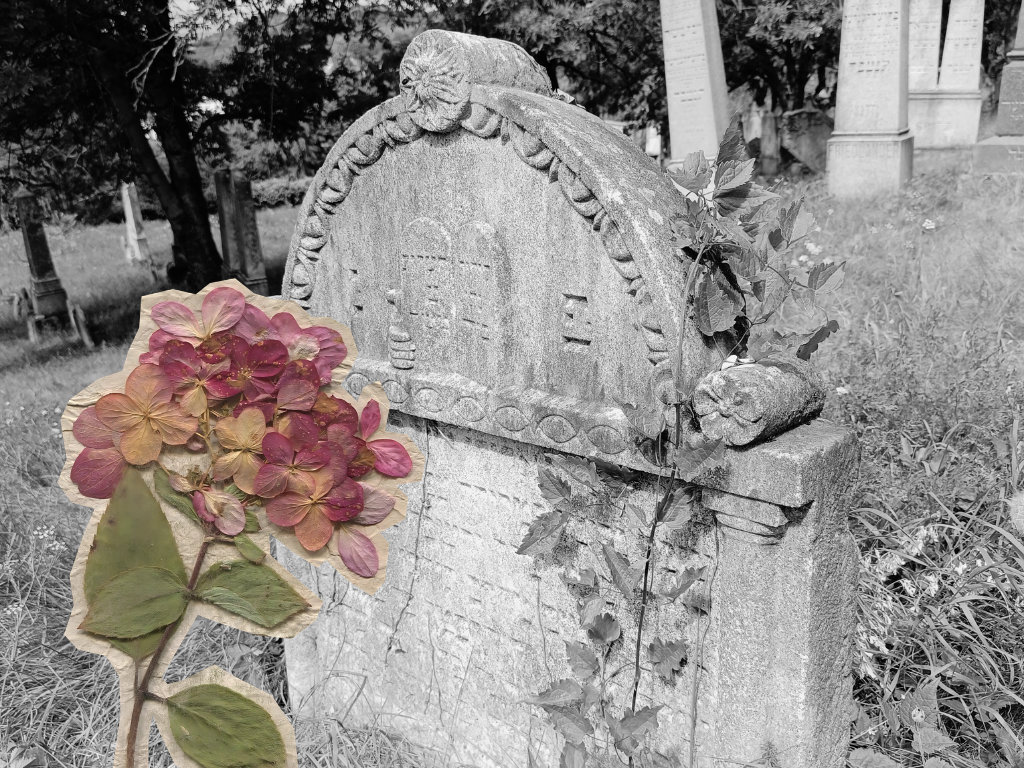
We’re going to a field in Mills County, a quiet stretch of land at the south end of a medical campus that, until June 30th, 2024, had been continuously occupied for nearly 150 years. On that land is a forgotten cemetery with about 1,300 people buried in generic, poorly marked graves. Some of the markers are missing.
The institution that surrounded that cemetery was known as the following throughout history:
- Iowa Soldiers’ Orphans Home
- The Iowa Asylum for Feeble-Minded Children
- The Iowa Institution for Feeble-Minded Children
- The Glenwood State Hospital-School
- The Glenwood Resource Center
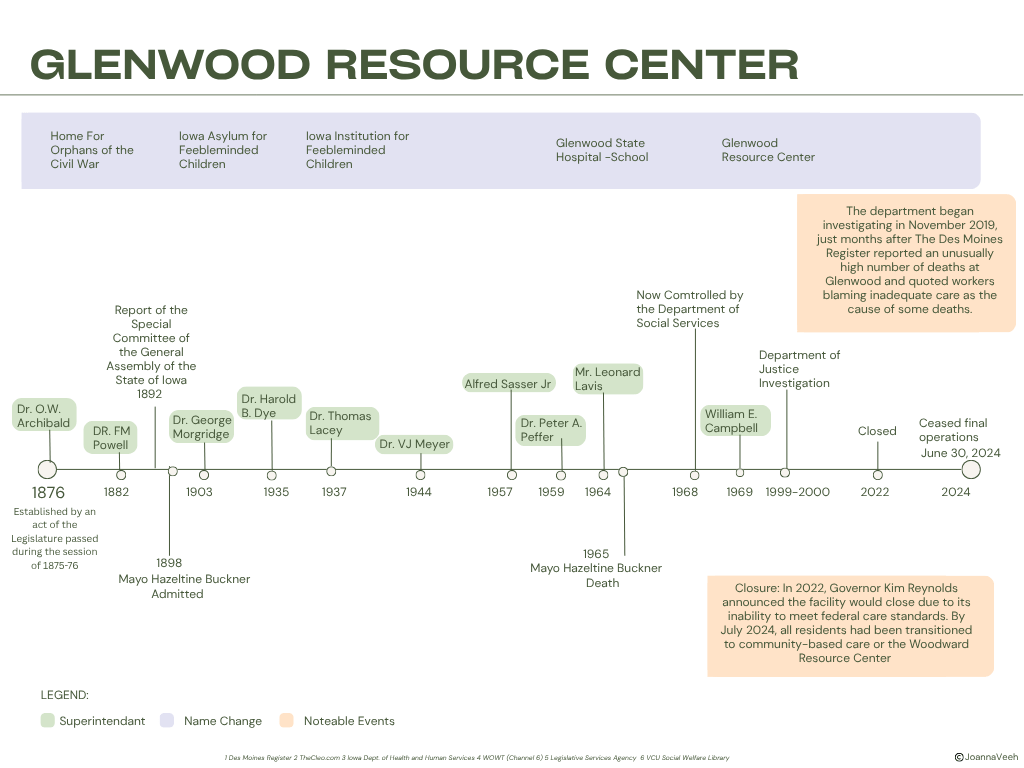
Each new name was an attempt to move forward. The names changed. The building stayed. The graves accumulated.
Field Note: The word “feeble-minded” eventually became a legal classification in Iowa, which meant that once it was applied to you, the institution had legal authority over your life. You didn’t have to have done anything wrong. You just had to have been labeled. (Worth filing that away as we go forward.)
The land in Glenwood had a history before it had residents with intellectual disabilities. It started as a response to the Civil War. Iowa passed an act on February 14, 1864, establishing a home for the orphaned children of soldiers who had died in service. On July 4th, 1866, a meeting was held in Council Bluffs, and the city of Glenwood was selected as the location. The Iowa Soldiers’ Orphans Home was born.
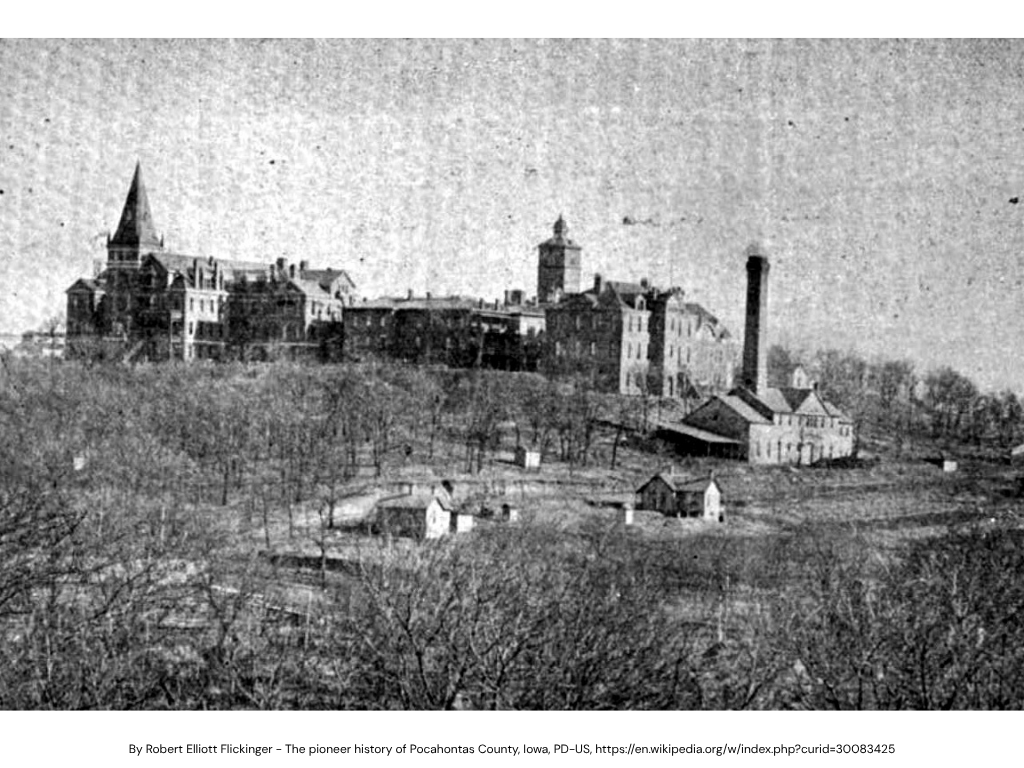
The transition from orphanage to asylum occurred in 1876, when the 16th General Assembly of Iowa voted in support of a bill drafted by John Y. Stone that formally established the Iowa Asylum for Feeble-Minded Children on the same grounds.
Iowa was the seventh state in the nation to create such a facility.
The first superintendent was Dr. O.W. Archibald, a Canadian immigrant, who opened the institution on September 1, 1876, and promptly noted in his first annual report that conditions were already crowded. (They would stay crowded for the next century.)
Let’s pause on something. A home for children left parentless by war (children the state had specifically created infrastructure to protect) was converted into a facility for children the state had decided were defective and needed to be managed.
The early campus was modest with male and female cottages, a central building, a small hospital, a bakeshop, ice and cold storage, a water tower, and a farm cottage for older boys. Designed “Cottage Style”. By 1889, the age of eligible residents had been raised, and the population had climbed to 815. A massive farm expansion pushed those numbers from 980 in 1903 to 1,695 by 1935, as the institution became, in the words of a WPA guidebook from the 1930s, a self-contained community, isolated from the rest of Glenwood by a wrought iron fence, with beautifully landscaped grounds and farm tracts tended by the residents themselves.
(The residents worked the farm. They also worked the bakeshop, the laundry, and the print press. They were, in many cases, unpaid labor sustaining the institution that held them. I want to name that plainly and then move on, because we will come back to it.)
The campus acquired its own railroad to deliver coal to the boiler room. There was so much coal that the ash was spread across decades to fill holes and resurface roads, distributed so widely across the grounds that “no matter where you dig on campus, you will find it.” Later, a tuberculosis building went up, and along with that, in the basement of that building, a morgue.
By the 1950s, the campus held nearly 1,900 people. It spanned 378 acres, expanded from the original 15.
The Case of Mayo Hazeltine Buckner
I want to tell you about Mayo Buckner. Because Mayo Buckner is, in the most literal, documented sense, a ghost of the Glenwood institution. Mayo Hazeltine Buckner was admitted to the Iowa Institution for Feeble-Minded Children in 1898. He was assessed and labeled this way at intake by an employee with no formal training, who classified him as a medium-grade imbecile. On that basis, he was committed. He was not released for fifty-nine years.
During those years, Buckner played eight musical instruments and even worked the printing press. When he was finally tested following the reforms of the late 1950s, his IQ registered at 120. That places him, by standard measures, comfortably above average, and well above the threshold that might have justified commitment under any honest application of the diagnostic criteria.
He had been in that institution for nearly six decades because a person with no credentials made a snap judgment in 1898, wrote it on a form, and the form became his life.
The story broke publicly when the new superintendent, Alfred Sasser, opened the campus to visitors in 1957, a kind of “institutional pride day”. A reporter from the Des Moines Register was there. The November 17th article revealing Buckner’s situation caused a sensation. Time magazine followed. Life magazine ran photographs in March 1958, including images of what were called “side rooms”, closet-sized spaces where residents who “misbehaved”.
Sasser resigned in March 1959. The story was dramatized on television. And Buckner, who had spent the entirety of his adult life inside those walls, died at Glenwood in 1965, having never left.
If that’s not haunting, I don’t know what one is.
Field Note: The cemetery markers at Glenwood went through several phases: upright stones, then flat concrete markers, then flat marble markers bearing only a last name, first initials, and plot number — reportedly in accordance with state patient confidentiality laws. The graves of people who were held there, sometimes against any reasonable interpretation of necessity, are marked with the minimum information the state was legally required to provide.
Why We’re Here
There are no ghost tours of the Glenwood Resource Center (not yet anyway). The campus only closed in 2024, and the redevelopment plans are still being negotiated.
The more interesting question, the one I keep coming back to, is this: “What does it mean that we’re only now calling what happened here an injustice?”
The DOJ investigation that led to Glenwood’s eventual closure was launched in 2019. Investigators found that residents had been subjected to medical experiments without consent, including overhydration trials that caused physical harm. They found plans for psychological research involving images of nude children. They found that the institution had been, in their words, deliberately indifferent to serious risks to resident health and safety. They concluded that conditions at Glenwood violated the Fourteenth Amendment of the United States Constitution.
The assistant attorney general, Eric Dreiband, said: “Individuals with disabilities are not human guinea pigs.” He said this in 2020. The institution had been operating since 1876.
The haunting, if there is one, is not spectral. It’s the gap between what the institution said it was doing and what it was actually doing, archived in boxes that are still being opened. We’re going to keep opening them together.
Sources & Further Reading
∙ F.M. Powell, M.D., “Care and Training of Feeble-Minded Children,” National Conference of Charities and Correction, Omaha, 1887 — via VCU Libraries Social Welfare History Project
∙ Iowa. Report of the Special Committee of the 19th General Assembly appointed to visit the Asylum for Feeble-Minded Children at Glenwood (1892) — Iowa Publications Online
∙ WOWT 6 News, “Former Glenwood Resource Center Workers Find Missing Cemetery Markers” (October 2024)
∙ KCCI 8 News, “Department of Justice Concludes Glenwood Resource Center Investigation” (2020)
∙ Glenwood Resource Center, Wikipedia
∙ Glenwood Resource Center Cemetery, Find a Grave
 by JoannaArcana
Leave a comment