

A Grounding Note on Ghost Hunting
This guide is meant to be educational, not instructional in a professional or medical sense. It does not diagnose, explain, or confirm the existence of paranormal activity, nor is it a substitute for professional advice of any kind. Any claims about paranormal phenomena—including the ones discussed here—should always be approached with curiosity and critical thinking.
As you read in my disclaimer in my opinion, critical thinking is the most important skill any paranormal investigator can develop. Paranormal investigation exists at the intersection of history, psychology, folklore, environment, and belief. That means skepticism and open-mindedness must coexist. Question everything. Especially your own assumptions.
It’s also important to acknowledge that paranormal investigations can involve real-world risks. Unsafe structures, private property, environmental hazards, and emotional distress are all far more common than ghosts. Investigations should only be conducted with proper preparation, respect for the law, and permission from property owners or managers.
Everything shared here is offered for learning and reflection only. By engaging with this content, you accept responsibility for how you choose to apply (or not apply) what you learn.
Above all, ghost hunting, whether you believe in spirits or not, requires respect. For places. For people. For history. And for yourself.
Ghost Hunting Month: Back to the Basics
Now for the fun part.
This month, I’ll be focusing on Ghost Hunting 101—cutting through the noise of TV shows, dramatic edits, and viral clips to focus on the foundations. There is no shortage of paranormal content. What is harder to find is grounded, accessible information that blends curiosity with responsibility.
My goal is to narrow things down to the essentials and explore ghost hunting through a thoughtful lens—supported by research, reflection, and yes, some aesthetically pleasing visuals along the way.
Rules of Engagement: Ethical Ghost Hunting
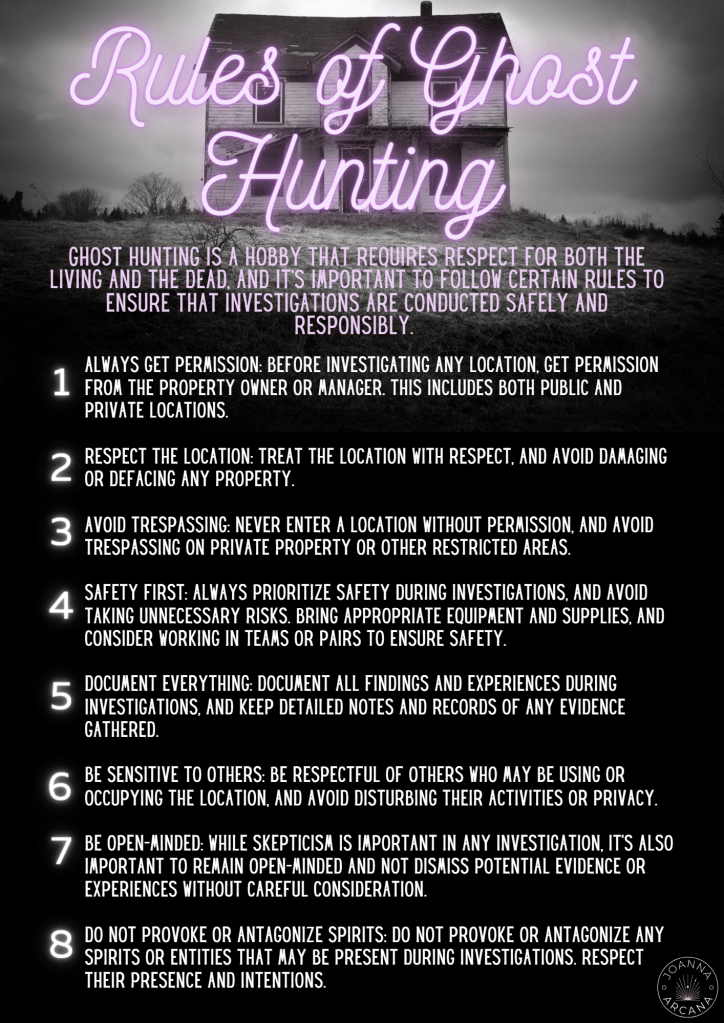
Ghost hunting is not about thrill-seeking or provocation. It’s about observation, documentation, and respect. These are the rules we’ll be operating under this month:
1. Always Get Permission
Never investigate a location without the owner’s or manager’s explicit permission. This applies to abandoned buildings, public spaces after hours, and private property alike.
2. Respect the Location
Leave no trace. Do not damage, remove, or alter anything. A location’s history deserves preservation, not disruption.
3. No Trespassing
If you are not allowed to be there, you do not belong there. Period.
4. Safety Comes First
No experience or piece of “evidence” is worth risking injury. Bring appropriate equipment, know your surroundings, and avoid investigating alone.
5. Document Responsibly
Take notes. Record conditions. Track times and locations. Good documentation matters more than dramatic conclusions.
6. Be Considerate of Others
Whether it’s nearby residents, security staff, or fellow investigators, respect privacy and boundaries at all times.
7. Stay Open—but Critical
Skepticism and openness are not opposites. Don’t dismiss experiences outright, but don’t accept them blindly either.
8. Never Provoke
Do not antagonize, challenge, or “taunt” supposed entities. Even from a skeptical standpoint, provocation adds nothing of value and can unnecessarily escalate situations.
These principles will guide everything we explore this month—from equipment and environments to ethics and interpretation.
Ghost hunting isn’t about proving anything. It’s about asking better questions.
Happy haunting!


 by Joanna Arcana
Leave a comment